 Facebook
 X
X LinkedIn
 Forward
Difficult Discussions in Oncology Nursing: Tools, Techniques and Compassion
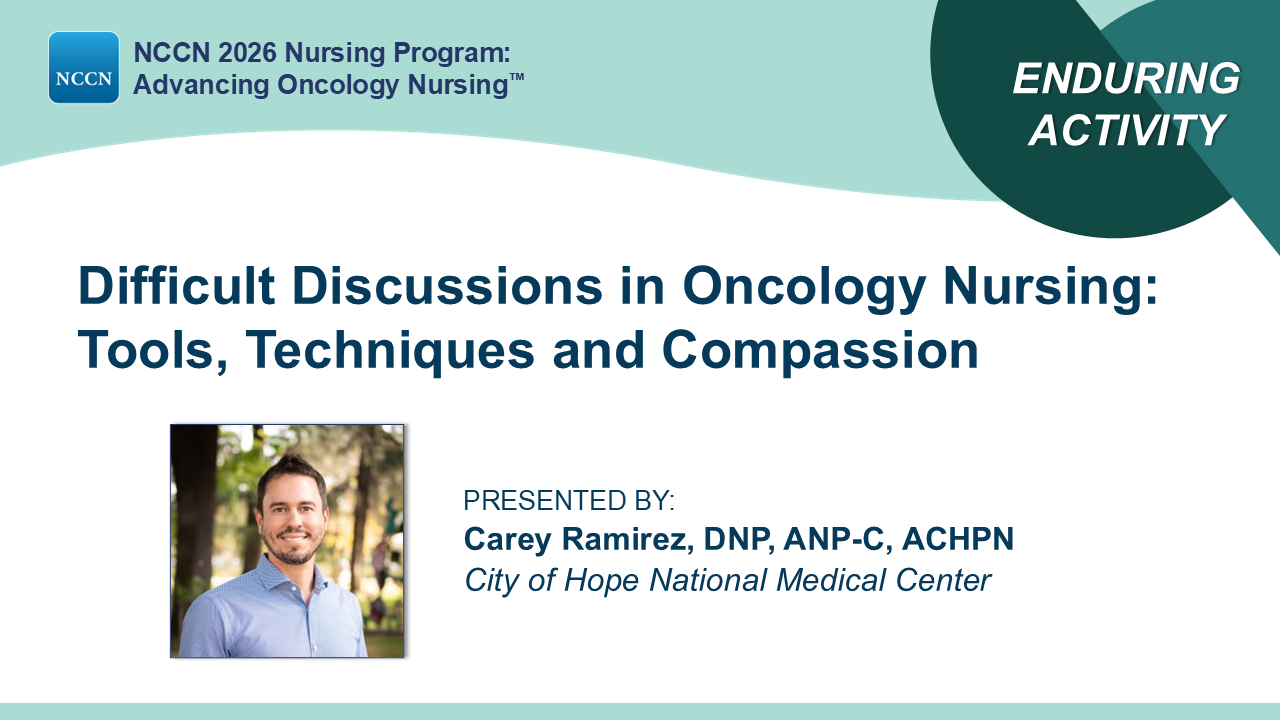
There is an unmet need to guide nurses to manage their intermediary role between patients, families/caregivers, and physicians. Using strategies like SPIKES (setting, perception, invitation, knowledge, emotions, strategy and summary), NURSE (name, understand, respect, support, explore), and ask-tell-ask during difficult conversations reduces stress on both the nurse and patient, resulting in more effective communication. Due to the frequency of interaction, effective communication skills are critical for the oncology nurse which will lead to improvements in patient centered care.
Target Audience
This program is designed to meet the educational needs of oncology nurses who treat people with cancer.
Learning Objectives
Following this activity, participants should be able to:
- Identify barriers to therapeutic communication.
- Recognize and respond to a wide range of emotions fostered by the patient and their caregivers.
- Incorporate communication models and strategies to navigate challenging interactions.
Course summary
- 0.75 ANCC contact hours
- 0.75 Participation
Amanda E. Visnick, RN, BSN, OCN (Nursing Program Moderator)
 | In support of improving patient care, National Comprehensive Cancer Network (NCCN) is jointly accredited by the Accreditation Council for Continuing Medical Education (ACCME), the Accreditation Council for Pharmacy Education (ACPE), and the American Nurses Credentialing Center (ANCC) to provide continuing education for the healthcare team. |
Nurses: NCCN designates this educational activity for a maximum of 0.75 contact hour.
Available Credit
- 0.75 ANCC contact hours
- 0.75 Participation
Required Hardware/software
To complete this activity, users will need:
- A device with an Internet connection and sound playback capability (speakers or a headset)
- Adobe Reader or other PDF reader software for certificate viewing/printing